
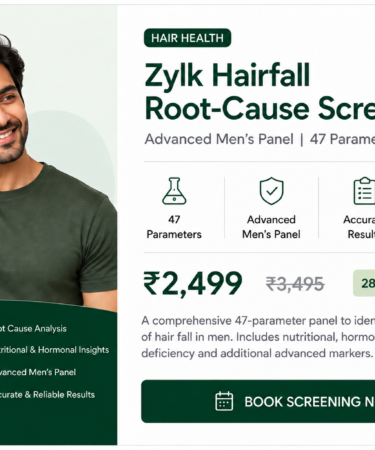
ADVANCED MEN’S PANEL · 47 PARAMETERS
Zylk Men’s Hairfall Root-Cause Screening
Hair fall can be multifactorial. A structured screen helps your doctor look beyond a single cause — nutrition, thyroid, iron, and hormonal signals, all in one panel.
₹3,800
Limited offer
- Report reviewed by doctors
- Free home sample collection at all district headquarters
- Remote locations: +₹300 sample-collection charge
- End-to-end sample tracking, temperature-controlled transport
Buy the test — ₹2,499
Why hair loss needs more than one answer
Male hair loss is rarely a single-factor issue. Genetics play a role, but unaddressed nutritional deficiencies, thyroid disruptions, elevated cortisol, and hormonal imbalances can significantly accelerate shedding and miniaturize follicles.
Nutrition & iron
Vitamin D, B12, ferritin, iron studies and CBC can identify deficiency or anemia patterns that may contribute to diffuse shedding.
Thyroid & metabolic signals
TSH, T3 and T4 help evaluate thyroid dysfunction — an established systemic cause of diffuse hair changes.
Androgen pathway
DHT and SHBG add context to male pattern hair loss, though scalp sensitivity and clinical pattern matter more than a single blood value.
Inflammation / systemic health
CBC, CRP and ANA provide context when illness, inflammation or autoimmunity is clinically suspected. These are not hair-loss-specific tests.
What your screening includes
47 parameters grouped across vitamin, thyroid, iron, complete blood count and additional hormonal markers.
- Vitamin profile — 25-OH Vitamin D, Vitamin B122 params
- Thyroid profile — Total T3, Total T4, Ultrasensitive TSH3 params
- Iron deficiency profile — TIBC, Serum Iron, % Transferrin Saturation, UIBC4 params
- Ferritin — iron-storage protein1 param
- Complete blood count — red cells, white cells, platelets, indices28 params
- Additional markers — DHT, SHBG, ANA, CRP, Cortisol, Calcium, Phosphorus, Magnesium, Zinc9 params
Take the first step toward clearer answers
₹2,499 · 47 parameters · Report reviewed by doctors
How it works
From booking to doctor review — a simple workflow built around home collection, traceability and controlled laboratory processing.
-
Book your test
Use the Zylk Health ordering link and choose a convenient collection slot.
-
Home sample collection
A trained collection professional visits your address. Free at all district headquarters; remote locations carry an additional ₹300 charge.
-
Barcode + temperature-controlled transport
Your sample is tagged with a unique barcode for end-to-end traceability and transported under temperature-controlled conditions.
-
Automated lab testing
Samples are processed on fully automated analyzers with routine laboratory quality checks.
-
Report reviewed by doctors
Your laboratory report is reviewed by doctors. Use the results together with your hair-loss history and a free doctor examination for treatment decisions.
Test-by-test guide — Vitamins & Thyroid
Five markers that help assess nutrient status and thyroid function — two common domains considered in diffuse hair shedding.
Vitamins
Nutrient-status markers
25-OH Vitamin D (Total)
What it means / why it’s done
Measures 25-hydroxyvitamin D, the main circulating marker used to assess vitamin D status. It is done to identify deficiency or insufficiency and to place bone/mineral health in context.
Hair-loss relevance
Associated / contributor. Low vitamin D has been reported in several nonscarring alopecias, including some patients with diffuse shedding.
How doctors use the data
Doctors interpret it with symptoms, diet/sun exposure and mineral results. Deficiency may be corrected when clinically indicated.
Vitamin B12
What it means / why it’s done
Assesses a vitamin required for DNA synthesis, neurologic function and normal red-blood-cell production. Deficiency can cause macrocytic anemia and systemic symptoms.
Hair-loss relevance
Contextual. Direct evidence linking isolated B12 deficiency to common male pattern hair loss is limited, but B12-related anemia or poor nutrition can coexist with diffuse shedding.
How doctors use the data
Doctors correlate B12 with CBC indices such as hemoglobin and MCV, dietary history and symptoms. If deficiency is confirmed, the cause and appropriate replacement are addressed.
Thyroid profile
Thyroid function markers
Total Triiodothyronine (T3)
What it means / why it’s done
Measures total T3, an active thyroid hormone. It is mainly used with TSH/T4 to characterize thyroid function when an abnormality is suspected.
Hair-loss relevance
Established systemic link. Both overactive and underactive thyroid states can disturb the hair cycle and contribute to diffuse thinning or shedding.
How doctors use the data
Doctors read T3 together with TSH and T4. Abnormal patterns may lead to repeat testing, free-hormone tests, thyroid antibodies or endocrine evaluation depending on the clinical picture.
Total Thyroxine (T4)
What it means / why it’s done
Measures total T4, the principal hormone produced by the thyroid gland. It helps characterize thyroid hormone production.
Hair-loss relevance
Established systemic link. Thyroid dysfunction may change hair texture, density and cycling; the laboratory pattern matters more than T4 alone.
How doctors use the data
Doctors interpret T4 with TSH (and often free T4 if needed) to distinguish hypo- from hyperthyroid patterns and decide whether additional thyroid evaluation is required.
Ultrasensitive TSH (uTSH)
What it means / why it’s done
Measures thyroid-stimulating hormone from the pituitary. TSH is a sensitive first-line marker for many thyroid disorders.
Hair-loss relevance
Established systemic link. Thyroid dysfunction is a recognized cause of diffuse hair changes, making TSH a common part of hair-loss work-ups when indicated.
How doctors use the data
Doctors use TSH as an anchor result and interpret it with T4/T3, symptoms, medications and prior thyroid history. An abnormal value is not treated based on hair loss alone.
Book once. Get a structured 47-parameter view of common contributors.
₹2,499 · 47 parameters · Report reviewed by doctors
Test-by-test guide — Iron status & Ferritin
Iron is best understood as a pattern: storage iron (ferritin), circulating iron, binding capacity and red-cell findings reinforce one another.
Total Iron Binding Capacity (TIBC)
What it means / why it’s done
Estimates the blood’s capacity to bind iron through transferrin. TIBC often rises when iron stores are depleted and can fall in some inflammatory or chronic conditions.
Hair-loss relevance
Common contributor. Iron deficiency and iron-deficiency anemia can contribute to diffuse hair shedding; TIBC helps distinguish iron-status patterns.
How doctors use the data
Doctors interpret TIBC with serum iron, transferrin saturation, ferritin and CBC rather than by itself.
Serum Iron
What it means / why it’s done
Measures circulating iron bound mainly to transferrin at the time of the blood draw. It can vary with time of day, recent intake and illness.
Hair-loss relevance
Common contributor, but variable. Low circulating iron can support iron deficiency when it matches ferritin/TIBC findings; a single serum iron value is not enough.
How doctors use the data
Doctors combine serum iron with TIBC/UIBC, transferrin saturation, ferritin and CBC. Discordant values may be repeated or investigated in the context of inflammation and diet.
% Transferrin Saturation
What it means / why it’s done
Calculates the percentage of transferrin binding sites occupied by iron. It is derived from serum iron and TIBC.
Hair-loss relevance
Common contributor. A low saturation can support iron deficiency, a recognized potential contributor to diffuse shedding.
How doctors use the data
Doctors use saturation to judge available circulating iron and cross-check ferritin/CBC. Very high or low values can point to iron-balance disorders needing follow-up.
Unsaturated Iron-Binding Capacity (UIBC)
What it means / why it’s done
Measures the transferrin binding capacity not currently occupied by iron. It complements serum iron and TIBC.
Hair-loss relevance
Common contributor. UIBC is not a hair test; it helps define whether iron depletion is present, which can be relevant to diffuse shedding.
How doctors use the data
Doctors read UIBC together with serum iron, TIBC and ferritin. Higher UIBC can occur with iron deficiency; interpretation depends on the full pattern.
Ferritin
What it means / why it’s done
Measures ferritin, the main storage form of iron. Low ferritin is a strong clue to depleted iron stores; ferritin can also rise during inflammation.
Hair-loss relevance
Commonly assessed. Low iron stores may contribute to diffuse shedding in some patients, though the ideal ferritin target for hair growth is not universally established.
How doctors use the data
Doctors compare ferritin with CBC, iron studies and CRP/clinical inflammation. Low ferritin may prompt investigation for dietary insufficiency or blood loss before replacement.
Complete Blood Count — all 28 parameters
The detailed CBC below expands the standard 28-part Complete Hemogram used for this panel. Final report labels can vary slightly by laboratory.
Red cells — oxygen delivery + anemia pattern
Especially useful when doctors ask whether anemia or a nutrient deficiency is contributing to diffuse shedding.
Hemoglobin (Hb)
What it means / why it’s done
Measures the oxygen-carrying protein inside red blood cells. Low hemoglobin is a core feature of anemia.
Hair-loss relevance
Contributor through anemia. Anemia can reduce oxygen delivery and often travels with iron, B12 or other deficiencies that may contribute to diffuse shedding.
How doctors use the data
Doctors classify the severity of anemia and combine Hb with MCV, MCH/MCHC, RDW, ferritin and B12 to identify the likely cause.
Hematocrit / PCV
What it means / why it’s done
The percentage of blood volume occupied by red blood cells. It usually moves in the same direction as hemoglobin.
Hair-loss relevance
Contributor through anemia. A low PCV supports reduced red-cell mass; it is not a hair-loss marker by itself.
How doctors use the data
Doctors use PCV with hemoglobin and RBC count to confirm an anemia pattern and assess whether dehydration or other factors may be affecting the result.
Total RBC Count
What it means / why it’s done
Counts red blood cells per unit of blood. The count helps separate different anemia patterns.
Hair-loss relevance
Contextual to hair loss. Low or abnormal red-cell patterns can point toward anemia or marrow/nutritional issues that may contribute to systemic shedding.
How doctors use the data
Doctors interpret RBC count with hemoglobin, hematocrit and cell-size indices; the relationship between these values can suggest iron deficiency, thalassemia traits or other causes.
Mean Corpuscular Volume (MCV)
What it means / why it’s done
Reports the average size of red blood cells. Low MCV suggests microcytosis; high MCV suggests macrocytosis.
Hair-loss relevance
High-value context. Iron deficiency often lowers MCV; B12/folate deficiency can raise it. Both are relevant when investigating diffuse shedding.
How doctors use the data
Doctors use MCV to classify anemia and decide which follow-up tests are appropriate, such as iron studies, B12/folate assessment or other evaluations.
Mean Corpuscular Hemoglobin (MCH)
What it means / why it’s done
Estimates the average amount of hemoglobin in each red blood cell.
Hair-loss relevance
Contextual. Low MCH commonly accompanies iron-deficient, smaller red cells; this can support a deficiency pattern linked with diffuse shedding.
How doctors use the data
Doctors interpret MCH with MCV and MCHC rather than alone to characterize red-cell morphology and anemia type.
Mean Corpuscular Hemoglobin Concentration (MCHC)
What it means / why it’s done
Estimates the concentration of hemoglobin within red blood cells.
Hair-loss relevance
Contextual. A low MCHC can support hypochromic anemia, often seen in iron deficiency. It is not a direct hair marker.
How doctors use the data
Doctors use MCHC alongside MCV, MCH, RDW and iron studies to refine the likely anemia pattern.
Red Cell Distribution Width – CV (RDW-CV)
What it means / why it’s done
Measures how much red-blood-cell size varies, expressed as a coefficient of variation.
Hair-loss relevance
Contextual. A rising RDW can appear with evolving nutrient deficiency or mixed anemia, which can be relevant in diffuse shedding work-ups.
How doctors use the data
Doctors compare RDW-CV with MCV and ferritin/B12. High variability can suggest more than one red-cell population or an evolving deficiency.
Red Cell Distribution Width – SD (RDW-SD)
What it means / why it’s done
Another measure of variation in red-blood-cell size, expressed as an absolute width.
Hair-loss relevance
Contextual. Like RDW-CV, it helps characterize anemia rather than diagnose hair loss.
How doctors use the data
Doctors use RDW-SD as part of the red-cell pattern, especially when MCV and RDW-CV need additional context.
White cells — systemic illness + immune context
Can identify infection/inflammation patterns that may matter to overall health. Not specific tests for hair loss.
Total Leucocyte Count (WBC)
What it means / why it’s done
Counts white blood cells, which respond to infection, inflammation, medications and marrow conditions.
Hair-loss relevance
Indirect. Acute or systemic illness can trigger telogen shedding, but WBC is not a hair-loss test and can be normal in hair disorders.
How doctors use the data
Doctors interpret total WBC with the differential counts and symptoms to decide whether infection, inflammation or hematologic follow-up is needed.
Neutrophils %
What it means / why it’s done
The percentage of circulating white cells that are neutrophils, the main acute bacterial/inflammatory responder.
Hair-loss relevance
Indirect. A change may reflect systemic illness that can secondarily affect hair cycling; it does not diagnose a scalp condition.
How doctors use the data
Doctors interpret the percentage with total WBC and the absolute neutrophil count; percentages can mislead when total counts are abnormal.
Neutrophils — Absolute Count
What it means / why it’s done
The actual number of neutrophils in the blood.
Hair-loss relevance
Indirect. Marked infection/inflammation or severe systemic stress can be relevant to telogen shedding; the count itself is not a hair marker.
How doctors use the data
Doctors often give the absolute count more weight than the percentage when assessing infection risk, inflammation, medicines or marrow function.
Lymphocytes %
What it means / why it’s done
The proportion of white cells that are lymphocytes, which are central to adaptive immune responses.
Hair-loss relevance
Indirect. Viral illness and immune changes can alter lymphocytes; some systemic illnesses may precipitate diffuse shedding.
How doctors use the data
Doctors read the percentage with total WBC and the absolute lymphocyte count, and investigate persistent abnormalities in clinical context.
Lymphocytes — Absolute Count
What it means / why it’s done
The actual number of lymphocytes in the blood.
Hair-loss relevance
Indirect. It provides systemic immune context, not a diagnosis of alopecia.
How doctors use the data
Doctors use absolute lymphocyte count to assess immune/viral patterns and determine whether a persistent abnormality needs follow-up.
Monocytes %
What it means / why it’s done
The proportion of white cells that are monocytes, cells involved in inflammation and tissue cleanup.
Hair-loss relevance
Indirect. Changes can accompany infection or inflammation but have no specific relationship to common male hair loss.
How doctors use the data
Doctors interpret the percentage with the absolute monocyte count and the rest of the WBC differential.
Monocytes — Absolute Count
What it means / why it’s done
The actual number of monocytes in the blood.
Hair-loss relevance
Indirect. Persistent elevation can reflect chronic inflammation, infection or recovery states; hair relevance is secondary.
How doctors use the data
Doctors investigate meaningful persistent abnormalities based on symptoms and the rest of the blood count.
White cells + marrow-response markers
Mainly broader health signals. Hair relevance is indirect.
Eosinophils %
What it means / why it’s done
The proportion of white cells that are eosinophils, often associated with allergy, asthma, parasites and some drug reactions.
Hair-loss relevance
Indirect / limited. Eosinophils do not diagnose hair loss; they may add context when allergic, parasitic or drug-related illness is suspected.
How doctors use the data
Doctors compare the percentage with the absolute eosinophil count and the patient’s symptoms before deciding whether additional testing is needed.
Eosinophils — Absolute Count
What it means / why it’s done
The actual number of eosinophils in the blood.
Hair-loss relevance
Indirect / limited. It is an immune-context marker rather than a hair-loss marker.
How doctors use the data
Doctors use the absolute count to judge whether eosinophilia is clinically significant and evaluate allergy, parasitic exposure, medications or other causes as appropriate.
Basophils %
What it means / why it’s done
The proportion of white cells that are basophils, a small population involved in allergic and inflammatory signaling.
Hair-loss relevance
Indirect / limited. Basophil percentage has no established standalone role in diagnosing common hair loss.
How doctors use the data
Doctors interpret it as part of the differential; isolated minor shifts are often less important than the overall blood-count pattern.
Basophils — Absolute Count
What it means / why it’s done
The actual number of basophils in the blood.
Hair-loss relevance
Indirect / limited. It contributes to general hematologic context rather than hair-loss diagnosis.
How doctors use the data
Doctors consider persistent or marked abnormalities in the context of allergy, inflammation or hematologic conditions.
Immature Granulocytes (IG)
What it means / why it’s done
Counts early granulocyte forms released from bone marrow, which may rise during acute infection, inflammation or marrow stress.
Hair-loss relevance
Indirect. A systemic illness severe enough to shift marrow output can also trigger telogen shedding, but IG is not a hair marker.
How doctors use the data
Doctors use IG with WBC/neutrophils and symptoms to assess whether an acute inflammatory or infectious process needs attention.
Immature Granulocyte % (IG%)
What it means / why it’s done
The percentage of white cells made up of immature granulocytes.
Hair-loss relevance
Indirect. It mirrors marrow response and systemic illness rather than a specific cause of hair loss.
How doctors use the data
Doctors interpret IG% with the absolute IG count and total WBC; abnormal results are followed according to the broader clinical picture.
Nucleated Red Blood Cells (NRBC)
What it means / why it’s done
Counts immature red blood cells in peripheral blood; they are usually absent or extremely low in healthy adults.
Hair-loss relevance
Indirect / not hair-specific. Their presence can signal significant physiologic or marrow stress and deserves medical interpretation.
How doctors use the data
Doctors evaluate unexpected NRBCs with the full CBC and clinical status; they do not use NRBCs to diagnose hair loss.
Nucleated Red Blood Cells %
What it means / why it’s done
Reports NRBCs as a percentage relative to counted blood cells.
Hair-loss relevance
Indirect / not hair-specific. It is a hematology context marker, not a hair marker.
How doctors use the data
Doctors use the percentage with the absolute NRBC count and other CBC abnormalities to decide whether further hematologic evaluation is needed.
Platelets — complete the blood-health picture
Help characterize clotting-cell number and size. Included in the complete hemogram but not established hair-loss biomarkers.
Platelet Count
What it means / why it’s done
Counts platelets, the blood cells involved in clotting and vascular repair.
Hair-loss relevance
Very indirect. Platelet abnormalities can reflect systemic illness, deficiency or marrow disorders, but are not a routine cause-marker for male hair loss.
How doctors use the data
Doctors evaluate low or high platelet counts for bleeding/clotting and systemic causes; hair decisions are not based on platelet count alone.
Mean Platelet Volume (MPV)
What it means / why it’s done
Measures the average size of platelets; larger platelets are generally younger and more active.
Hair-loss relevance
Very indirect. MPV is not a validated hair-loss biomarker.
How doctors use the data
Doctors interpret MPV with platelet count and clinical context when evaluating platelet production or turnover.
Platelet Distribution Width (PDW)
What it means / why it’s done
Measures the variability in platelet size.
Hair-loss relevance
Very indirect. It adds hematologic detail rather than hair-loss information.
How doctors use the data
Doctors use PDW with MPV and platelet count if platelet abnormalities need characterization.
Plateletcrit (PCT)
What it means / why it’s done
Estimates the fraction of blood volume occupied by platelets, analogous to hematocrit for red cells.
Hair-loss relevance
Very indirect. It is not used to diagnose hair loss.
How doctors use the data
Doctors interpret PCT with platelet count/MPV when assessing platelet mass and hematologic patterns.
Platelet Large Cell Ratio (PLCR)
What it means / why it’s done
Estimates the proportion of larger platelets in circulation.
Hair-loss relevance
Very indirect. There is no established standalone role in common hair-loss evaluation.
How doctors use the data
Doctors use PLCR only as supportive platelet information when the platelet count or other indices are abnormal.
Additional markers
Androgen, inflammation and autoimmune context — most valuable when interpreted with clinical pattern, symptoms and the rest of the panel.
Dihydrotestosterone (DHT)
What it means / why it’s done
Measures a potent androgen produced from testosterone by 5-alpha-reductase. DHT is biologically important in androgen-sensitive tissues.
Hair-loss relevance
Direct biology for male pattern hair loss. Genetically susceptible scalp follicles respond to DHT with progressive miniaturization — but serum DHT does not directly measure follicle sensitivity or scalp DHT.
How doctors use the data
Doctors use DHT as contextual androgen information, not as a standalone diagnostic test. Male androgenetic alopecia is usually diagnosed from pattern, history and scalp examination.
Sex Hormone Binding Globulin (SHBG)
What it means / why it’s done
Measures the blood protein that binds sex hormones, especially testosterone and DHT, influencing the amount that circulates unbound.
Hair-loss relevance
Contextual. SHBG can alter androgen availability, but its direct value as a hair-loss marker in men is limited.
How doctors use the data
Doctors may use an abnormal SHBG as a clue to broader endocrine, liver, thyroid or metabolic context and may order additional androgen tests if clinically indicated.
Anti-Nuclear Antibody (ANA)
What it means / why it’s done
Screens for antinuclear autoantibodies that can occur in systemic autoimmune connective-tissue diseases. A positive result is not a diagnosis and can occur in healthy people.
Hair-loss relevance
Contextual / not hair-specific. Some autoimmune diseases can cause hair loss, but ANA is most useful when symptoms or examination already create clinical suspicion.
How doctors use the data
Doctors interpret ANA with history and physical findings. A positive result may lead to targeted autoantibody testing or rheumatology review; treatment should never be based on ANA alone.
C-Reactive Protein — Quantitative (CRP)
What it means / why it’s done
Measures an acute-phase protein that rises with inflammation, infection or tissue injury. It is deliberately nonspecific.
Hair-loss relevance
Indirect. Significant systemic illness or inflammation can trigger telogen shedding, but CRP does not diagnose a hair disorder and may be normal in many hair-loss conditions.
How doctors use the data
Doctors use CRP to judge whether a broader inflammatory process may need attention and interpret it with symptoms, CBC and other findings. Persistent elevation usually needs cause-focused evaluation.
Cortisol
What it means / why it’s done
Measures the adrenal glucocorticoid cortisol, which follows a strong daily rhythm and changes with illness, sleep, medications and stress.
Hair-loss relevance
Contextual. Physiologic and psychological stress can be associated with telogen effluvium, but one serum cortisol value does not diagnose “stress-related hair loss.”
How doctors use the data
Doctors interpret cortisol according to collection time and the reason for testing. Truly abnormal results may need confirmatory endocrine testing rather than hair-specific treatment.
Mineral profile
Zinc has the clearest direct deficiency-related hair relevance in this group. Calcium, phosphorus and magnesium are primarily broader nutritional/metabolic context markers.
Calcium
What it means / why it’s done
Measures circulating calcium, important for bone, nerve and muscle function. Total calcium can be affected by albumin levels.
Hair-loss relevance
Limited / contextual. Severe mineral or endocrine disturbances can accompany systemic illness, but calcium is not a routine standalone marker of common male hair loss.
How doctors use the data
Doctors interpret calcium with symptoms and, when needed, vitamin D, phosphate, albumin, kidney or parathyroid testing. Abnormalities are treated for their medical cause.
Serum Phosphorus
What it means / why it’s done
Measures blood phosphate, a mineral involved in bone structure, cell membranes and energy metabolism.
Hair-loss relevance
Limited / contextual. Marked phosphate abnormalities can reflect nutritional, kidney or endocrine problems, but direct evidence for common male hair loss is limited.
How doctors use the data
Doctors interpret phosphorus with calcium, vitamin D, kidney function and clinical context. Abnormal values may prompt evaluation for the underlying metabolic cause.
Magnesium
What it means / why it’s done
Measures magnesium, a mineral needed for enzyme activity, neuromuscular function and cellular metabolism.
Hair-loss relevance
Limited / contextual. Deficiency may signal poor intake, gastrointestinal loss or other illness, but magnesium is not a validated standalone cause-marker for male pattern hair loss.
How doctors use the data
Doctors use the result mainly as part of overall nutritional/metabolic assessment and correct confirmed abnormalities when clinically appropriate.
Serum Zinc
What it means / why it’s done
Measures circulating zinc, an essential mineral for protein/DNA synthesis, immune function and normal tissue growth.
Hair-loss relevance
Plausible contributor. Clinically significant zinc deficiency can be associated with diffuse hair loss, although routine zinc supplementation without deficiency is not proven to improve all alopecias.
How doctors use the data
Doctors interpret zinc alongside diet, symptoms and other nutrient markers. Confirmed deficiency may lead to dietary review or supervised replacement and investigation of the cause.
Turning numbers into clinical meaning
The report is a starting point. The useful unit is the pattern — not the isolated abnormal flag.
Pattern A
Ferritin low + transferrin saturation low + TIBC/UIBC high + microcytic CBC
Pattern B
TSH abnormal with concordant T4/T3 changes
Pattern C
Classic temple/crown miniaturization + family history, while vitamins/CBC/thyroid are normal
Pattern D
WBC/CRP abnormal after recent illness + sudden diffuse shedding weeks later
Scientific references & evidence notes
- Androgenetic Alopecia: Therapy Update (2023) — diagnosis is primarily clinical; basic labs such as TSH, CBC, iron/ferritin and vitamin D may be used to look for other contributors in patients with shedding/thinning.
- The Hormonal Background of Hair Loss in Non-Scarring Alopecias (2024) — reviews androgen, thyroid and stress-hormone biology in common nonscarring alopecias.
- Expert consensus on the management of Telogen Effluvium in India (2019) — lists CBC, vitamin D and thyroid testing as basic investigations and describes targeted use of iron, B12, zinc and hormonal assays.
- The Role of Vitamins and Minerals in Hair Loss: A Review (2019) — reviews evidence for vitamin D, iron, zinc, B vitamins and other micronutrients in nonscarring alopecia.
- Supplementation and hair growth: patients with alopecia and laboratory abnormalities (2022) — notes associations of alopecia with abnormalities in TSH, ferritin, zinc and vitamin D while emphasizing limits of supplementation evidence.
- The Diagnosis and Treatment of Hair and Scalp Diseases (2016) — highlights ferritin and thyroid testing in diffuse effluvium and the clinical nature of androgenetic alopecia diagnosis.
- American College of Rheumatology: Antinuclear Antibodies (ANA) (updated 2025) — explains that a positive ANA is not by itself diagnostic of autoimmune disease and must be interpreted with clinical history.
- Telogen Effluvium — review of the science and current obstacles (2021) — reviews physiologic stress as a trigger for diffuse telogen shedding and the limitations of current mechanistic understanding.
Is this screening for you?
Especially relevant when hair fall is persistent, diffuse, unexplained, or occurring alongside diet, stress, thyroid, anemia or nutritional concerns.
Consider screening if
You’ve had ongoing or increased shedding for several weeks/months, are concerned about iron/nutrient status, have thyroid history or symptoms, follow a restricted diet, had recent physiologic stress or illness, or want a fuller baseline before a doctor visit.
Also get a scalp exam if
You notice receding temples/crown thinning, miniaturization, scalp scale or itch, patchy bald spots, broken hairs, or you’re unsure whether it’s shedding vs. pattern loss.
See a doctor promptly if
There’s sudden patchy hair loss, scalp pain, pus or scarring, eyebrow/body-hair loss, severe fatigue, weight change, fever or other systemic symptoms, or markedly abnormal labs.
After your report
Review abnormal or borderline results with a Zylk Health doctor: which findings are truly relevant, what needs confirmation, what diagnosis fits your scalp pattern, and what should be treated, monitored or ignored.
Ready to stop guessing?
₹2,499 · 47 parameters · Report reviewed by doctors
Order the screening
ZYLK HEALTH
One test. 47 parameters. A clearer conversation with your doctor.
Designed to make the next step in your hair-health journey more informed — not more confusing.
Limited offer ₹2,499 · Free home sample collection at all district headquarters.


Customer reviews
Reviews
There are no reviews yet.
Write a customer review